Hey yall! One thing we had to figure out quick when starting (and maintaining) RV life was how to budget. I’ve tried purchasing yearly budget books before or creating Excel spreadsheets, but I would always forget about the book thus wasting the pre-dated pages, and sometimes I would prefer to physically write out my budget vs the digital spreadsheet. In this post, I’m going to break down the super simple budget sheet I created and also share the blank budget tracker for you to download! This budget tracker is simple, dateless, and broad so you can definitely make it meet your needs.
Tracker Breakdown
The first page of the tracker focuses on your monthly budget goals, broken down into six categories: income, rent/notes, food, bills, gas, and miscellaneous.
The income column helps me see how much I have to spend (or save!) that month.
Rent/notes I use for campground rent if staying long term or nightly campground fees. The notes part is for active loans/notes we pay monthly such as the truck, camper, etc.
Food budget I break into two categories: eating out and groceries. Usually, these amounts vary depending on how much we travel in that month. Our food budgets also vary depending on where we camp – if we camp in Thousand Trails for extended periods (like we did this summer down the PNW), then our eating out budget goes up since our rent/campground fee costs go significantly down.
The bills column is for any other monthly recurring payments like Starlink, Tmobile, insurance, etc.
Gas is for our diesel budget. This one also fluctuates a lot depending on if we are stationary in Utah (working from home), stationary bouncing between Thousand Trails (exploring area still), or going a long distance in a short time (making multiple overnight stops per week).
And the misc column is for anything extra! One month we may be planning to attend a concert and buy merch, or perhaps we will be near family/friends and want to budget for one-time experiences.
The next few pages of the tracker are broken down by week with a spot for each day’s expenses. This is where I would track daily expenses (ex. on Monday, $7 coffee, $30 eating out, truck note due…).
The last page is where you can total up your actual monthly spending to see where you compare to the budget set at the beginning of the month. In the notes section, I like to indicate if I was over/under budget and why.
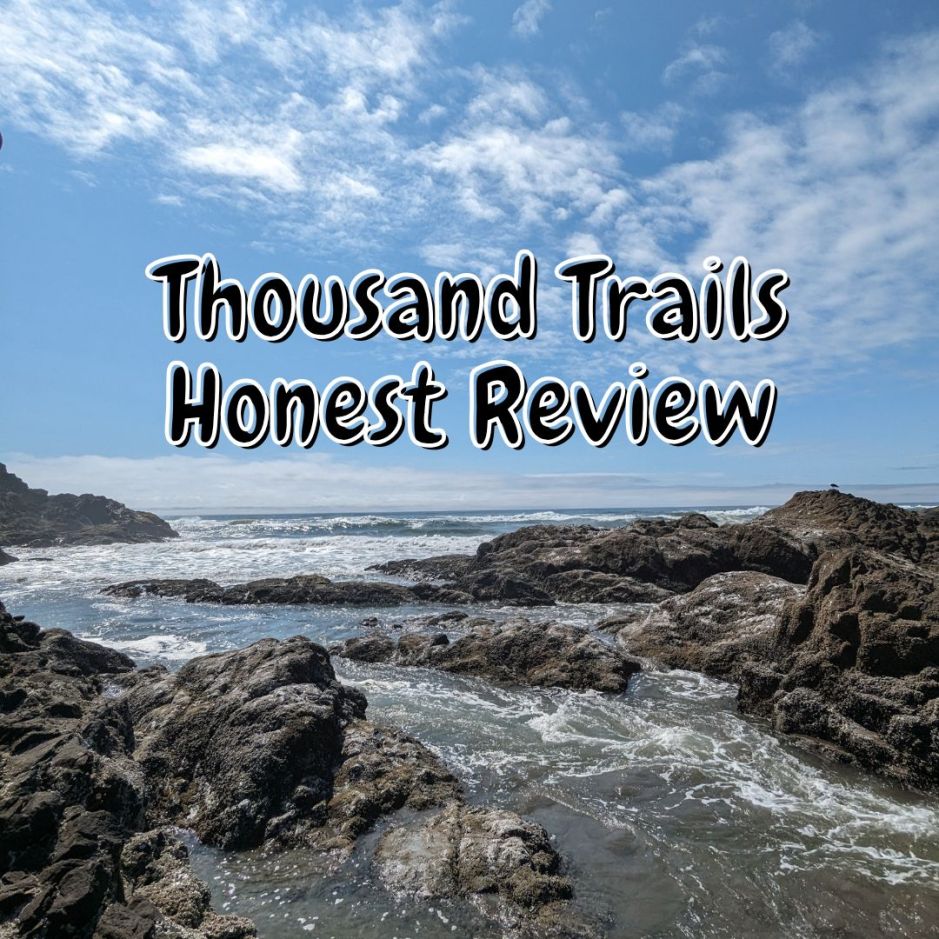
Hey y’all and welcome to my thousand trails honest review. We’ve had TT for a little over a year now, we actually just renewed our dues during the summer, and I wanted to give an honest opinion about everything we’ve encountered while using TT. I talk about TT a lot in my videos, but this is my unfiltered opinion on sites, amenities, bookings, check in process, and due renewal prices. Is TT a full timers dream or a scam? Let’s get into it! Below is the video version of this post if you’d prefer to check that out!
Note, this is not strictly about the difference between the passes, for that information please check out my TT breakdown video here:
Booking & Check In Process
A stay at TT starts with booking your site online. It is highly recommended to book online, but there is phone help available if you’re having trouble or have questions. Normal bookings are super easy, you log in, find the campground you want to go to (as long as it’s included in your membership), and then check to see if your dates are available to book. The only issues we had with booking were trying to book the Florida keys which are highly coveted. For the Keys, we never did get a booking even though I was on at midnight when the booking window opened. Once you complete your booking, you’ll get a confirmation email, and you can manage your bookings online to extend, shorten, or cancel. There is no penalty to cancel or edit bookings, which is a huge plus over normal campgrounds that charge a non refundable deposit or fee if canceled too close to check in. About a week before your stay, TT sends an email for online check in, which we always do. That way when we arrive at the campground, they already have our car tags and map ready to go! This process is quite easy, and it’s nice that it’s all online. Also, there is no waiting for the campground to approve your reservation, you’ll know immediately if you can book or if the dates aren’t available.
Sites
Here’s our biggest grief about TT – picking a site. The TT campgrounds operate on a first come first serve basis, which can be totally fine in larger campgrounds like the Orlando TT with 500 spots, but tedious in smaller campgrounds with 150 spots. Especially when some of the sites are annual sites but are not marked as unavailable on the map. This can cause you to circle looking for a site for a while, but I also personally prefer assigned spots so this might not be an issue for you. In the encore TTs we stayed in near Orlando, they did assign sites, so this seems to be more of a traditional TT kind of thing. We’ve also noticed the campgrounds on the northwest coast from the Seattle area through Florence, Oregon are not full hookups. It might be that these were older campgrounds, but it seems to be very common out there. The Oceana TT had three 50 amp sites and a small handful of sites with sewer. The rest were 30 amp with water only. At Pacific City TT, all sites are 30/50 amp with water, but a select few had sewer and most of those were annual sites. We did luck out with a really nice, quiet site in Pacific City but without sewer. In these situations where full hookups are not available for the majority of the park, there is a dump station available. TT is beginning to roll out in select campgrounds the ability to select your power type when checking in, and the South Jetty TT was one of them, so I was able to select 50 amp when checking in because it’s also quite frustrating when there’s only a few 50 amp sites and you see a 20 amp camper or a tent camping in one. I do wish TT would assign sites as I think this would solve a few of the headaches when arriving. Starlink has been our best friend in TTs until our site in Pacific City, which was covered with super tall trees. Starlink does not like the trees of the PNW, that’s for sure, but this is also something that would happen in any campground. Just a note for campgrounds in general, but always check the aerial view of the campground on google maps to get an idea if trees will be an issue for your Starlink.
Amenities
My favorite campground topic – amenities! Campgrounds with hot tubs are by far my favorite. Have you noticed many hotels now a days have bricked over their hot tubs? We’ve seen that in the hotels we’ve stayed in this year on our drives without the camper to Arkansas and Washington. Bathrooms are also a hot topic for campgrounds, TT bathrooms are a hit or miss on how they are laid out, but they are always clean in our experience. While other independent campgrounds can vary with bathroom layout as well, I like how TT has a cleaning sheet on the back of the doors so I can see when the bathroom was last cleaned; it’s like a super ridiculous detail, but it makes me feel better knowing the bathroom had been cleaned twice already that day. TTs also usually have events like movies or bingo or yard games, which we don’t participate in, but families with younger kids seem to enjoy. These aren’t necessarily specific to TT, but I’ve had pretty good luck with TT amenities more often than independent campgrounds.
Dues
The last thing I want to mention is dues. If you only pay the dues and pick one region to camp in (i.e. the camp pass) you pay only the dues each year. If you want the encore TT campgrounds in addition to the regular TT campgrounds, then you need to also buy the trails collection. Both the dues and trails collection can increase in price each year as costs and whatnot fluctuate. You can pause though if you want to take a break from camping for a while. We’ve personally decided for us that if we end up staying stationary for more than 6 months, it would be more beneficial to pause. If you upgrade, you will have to pay the upgrade cost only once (or finance and pay monthly until paid off), but you will still have to pay dues and the optional trails collection every year. We just paid our dues and the trails collection as we found the trails collection very useful in the east, which came down to $80ish a month. We do budget and save so that we can pay in full and not have to worry about a monthy payment for our dues, but I realize that’s not an option for everyone. However, $80 a month is like one or two nights in a KOA. I’m happy to pay $80 a month to stay along the Pacific Northwest for months at a time versus a $1200 monthly campground rate or our old $2100 a month apartment rent. This would have been closer to $40 a month if we had not done the trails collection, but we plan to be in the east around spring and there are a ton of encore TTs out there to make it worth it.
To be honest, TT is not for everyone, but it has been working out well for us as full timers. We’ve been able to stay for extended periods in some wonderful places, been able to see family for longer than a week or two by staying in nearby TTs, and traveled to some states we hadn’t planned on visiting if it weren’t for a TT nearby. We also enjoy finding a TT to stay in and planning a trip around the area, like staying in the Pacific City TT and then visiting the Tillamook creamery. If you’re hesitant to upgrade, don’t do it right away! Try out the camp pass and pick the quadrant you would most likely travel in. Maybe skip the trails collection if it wouldn’t benefit you. We started out with the camp pass before we went full timing, and full timing was what made us upgrade if I’m being honest so that we could have the whole country worth of campgrounds available To us. If we hadn’t gone full timing, we might have stuck with the northwest quadrant. But we are definitely happy that we upgraded to connections, it serves our full timing needs very well.
If you’ve made it this far into the post or watched the video, thank you! I make these posts and videos in my spare time to share the information I would have wanted to see when I was researching TT. If you’re curious to learn more, feel free to ask questions in the comments and I’ll try my best to answer from my personal experiences as I am not an agent.
Would you join TT or stick to independent campgrounds?
Almost one year ago (technically February 19), we moved into our 35ft travel trailer with our two cats. We purchased our camper in November 2022, had it delivered December 2022, moved it to the KOA in January 2023, and moved out of our apartment in February 2023. In June 2023, we left the KOA to travel and just recently returned in January 2024 for ski season. We’ve learned a lot over the year, not all good things, but the big question stands – would we do another year?
Lets talk about some of the good things we’ve learned and experienced during our year of RV life.
Intentional purchasing
I wouldn’t say we were over consumers in the apartment, but moving out was full of decluttering and donating. We kept necessities, extras of items we use often (like towels, toilet paper, soaps, etc), and sentimental things we couldn’t part with. I did make myself condense all of my holiday decor into one medium sized box, which lives in the under bed storage. The decor in the camper came from the apartment, with the exception of the clock in the bathroom.
There have been tons of times living in the camper where I’d see something cute at target that I would have bought in the apartment, but I had to take a minute to think of it had a place in the camper. Most of the time, the answer was no. And honestly, that was ok. We grew tired of the clutter in our apartment, and in the camper we try our hardest not to have clutter on sitting areas, on the counters, or in places we’d have to move on travel days.
Not only does intentionally choosing what we bring into the camper save us money, but it saves us the headache of running out of space. A good rule we like to follow is one thing in, one thing out. I usually apply this rule to clothes. I have a ton of t shirts that I’ve had for quite some time, so if I buy a new shirt at a national park, I can easily find an old shirt to either donate or throw away (if it has holes and such). I will say, I don’t apply this rule to mugs….
Traveling more than PTO allows
Another huge plus side of RV life for us was the ability to travel more than 2 weeks out of the year. We had a few hiccups in the beginning, figuring out which days work best to travel around our work schedules, but we figured it out pretty quickly. Especially after we implemented our 350 mile max in a day rule. Looking back on this year, we wouldn’t have traveled to half of the places we went, gone to any of the concerts we saw, or seen most of the family we were able to visit.
Your home is with you always
There’s something to be said about having a long travel day and still being able to sleep in your bed every night. We were able to shove our mattress from the apartment into our RV bedroom, which was a phenomenal effort. We had to transfer it to the camper, get it through the door, and then squeeze it through the bedroom onto its platform. And it is TIGHT. Like we have to pull it out a few inches to get the sheet on, and it’s a two person job. Having the comfort of a nice mattress every night though was worth the effort. Especially if you’ve ever slept on a stock RV mattress. No thanks.
Also, all of your stuff is with you! There’s so fear of arriving to your destination to realize you forgot your earbuds, chargers, soap, skin care, or toothpaste. Or course some of these things you can buy at a nearby store, but not if you’re boondocking or in a more remote campground. Also, who wants to replace things they totally meant to pack?? RV life gave us the comfort of not having to remember the small things to pack for a camping trip.
Campground utilities
At our apartment, we were spending $60 minimum for water and trash plus $100 minimum for electricity. At campgrounds with monthly rates, they tend to build in utilities at a flat rate. For example, the KOA we stayed at had a $50 a month flat fee for electricity, water, and sewer. Imagine paying $50 a month for electricity when You’re running 2 ac units NON STOP. That’s nothing! Additionally, if you’re willing to look into local campgrounds for your nightly rates, they can be as low as $40 for full hookups! We’ve found cheaper, but mostly in Texas.
Campground showers are a hot topic. Are public showers ok to use? We say yes, if they’re clean and well kept. Our favorites are the ones where it’s individual cubicles basically. You have a full locking door with a shower, toilet, and sink inside. Completely private to you. We don’t mind clean showers with curtains, but I prefer to only use those if I’m the only person in the entire bathroom. If you’re looking for a nice long shower, campground showers are the way to go! Most of the time they’re free too.
Small space = less cleaning
I don’t mind cleaning, but I don’t care to clean a large space every day. It’s so much easier to keep up with cleaning in a 200 sq ft space. It literally takes 2 minutes to vacuum or mop. The countertops may be small, but it’s easy to wipe down in less than 5 minutes. It’s a very small thing, but it’s definitely a pro to RV life.
Thousand Trails
I’ll keep this one quick – our first stint in TT in Orlando, FL this summer/fall saved us over $4000 in campground fees. This video explains more about TT and the pass we have!
TT is what allowed us to stay in spots for longer than 5 nights without blowing the budget out of the water. TT is also what’s going to allow us to spend 3 1/2 months in the PNW this summer!
While there are many other good things about RV life, let’s move onto the not so good things we’ve encountered while living in our RV
No bathtub
Ok this one’s a little silly, but I miss my bathtub the most. Bathtubs are hard to come by in campers. I miss my bathtub because there was nothing better than ending a long day at work by coming home to a hot bath and some bubbles.
Constant moving
A pretty big downside to RV life is constant moving, unless you stay in the same campground for multiple months at a time. Typically, we stay in TT campgrounds where the max stay is 14-21 days depending on the campground. That’s why you’ll find a lot of people with TT memberships rotating between nearby campgrounds. This is especially easy in Florida, Arizona, and the coastal areas where there’s a high concentration of TTs.
However, the constant moving can be tiresome after a while. Towing a camper comes with more to look out for while driving, and travel days can take a lot out of anyone involved. If you’re having to move every few days it gets very tiresome. When we were able to stay in one place for 21 days at a time, it felt like forever. So being back at the KOA for a while is a nice break.
Snowbird season
Snowbird season is awful for booking campsites in most places people like to winter in RVs. Thankfully we prefer the snow and cold, so we go the opposite way of the snowbirds. However, we did overlap in Florida before Thanksgiving. Trying to find a campsite was very, very difficult as more and more people were flocking to Florida.
Of course, there are a few more annoyances to RV life that I haven’t mentioned here, just like there are more great things about RV life, but these are the ones that stood out most to us. What are your favorite or least favorite parts of RV life? Or if you’re not a full timer, what do you think would be the reasons you’d start or stop RV life?
And the big question – would we do another year? The short answer is yes, but we’d do it a little differently. Follow along to find out how in the coming months.
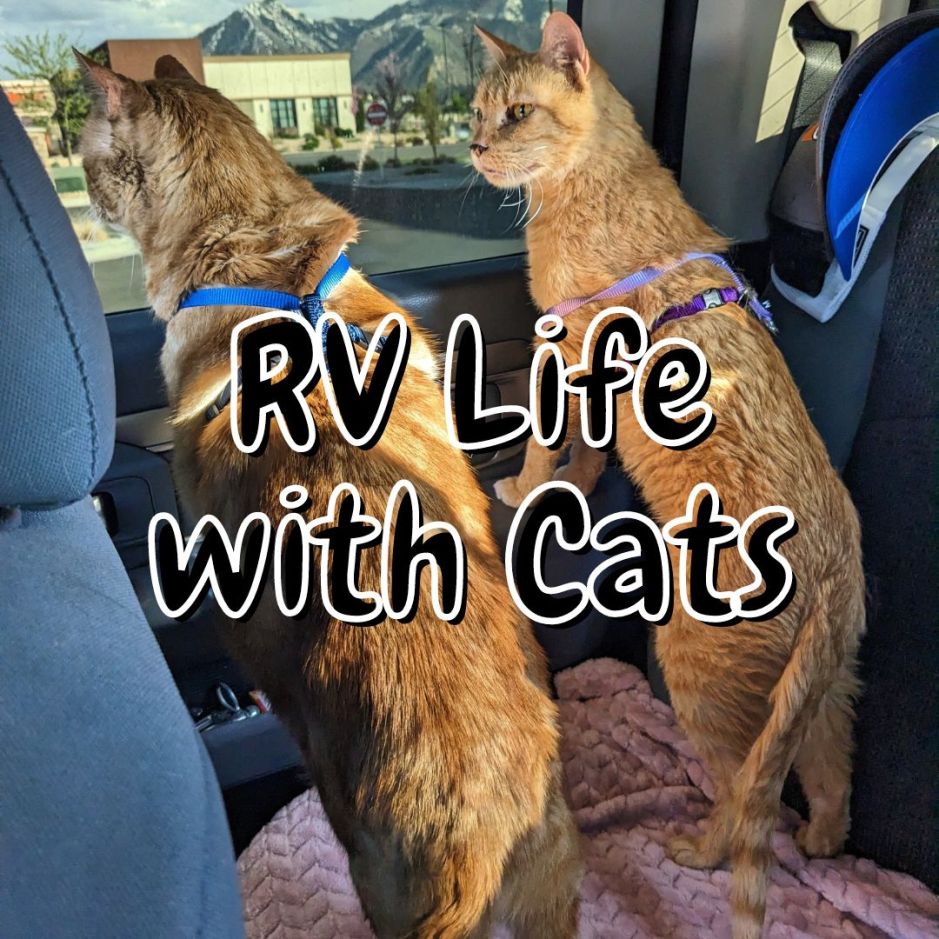
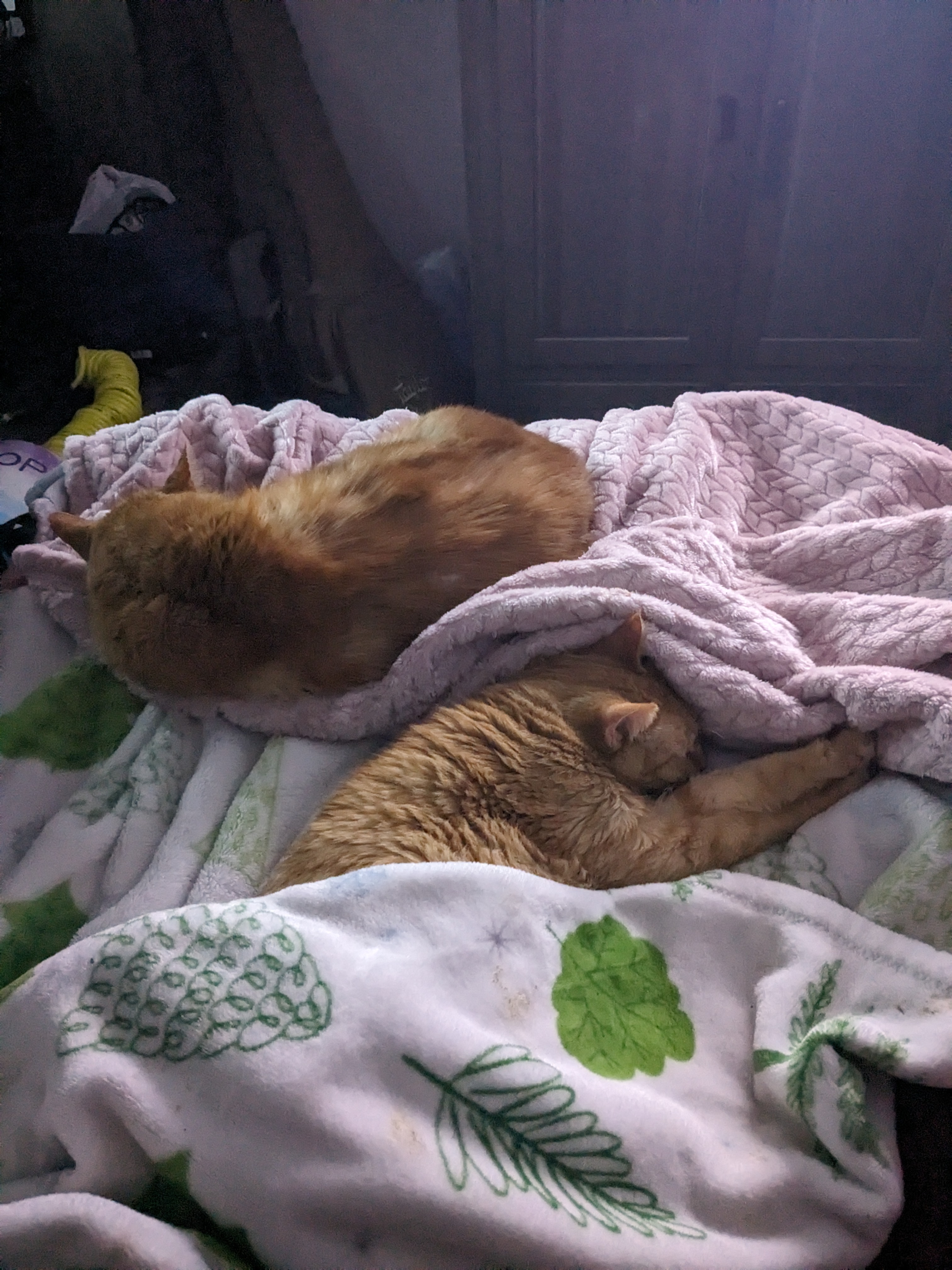
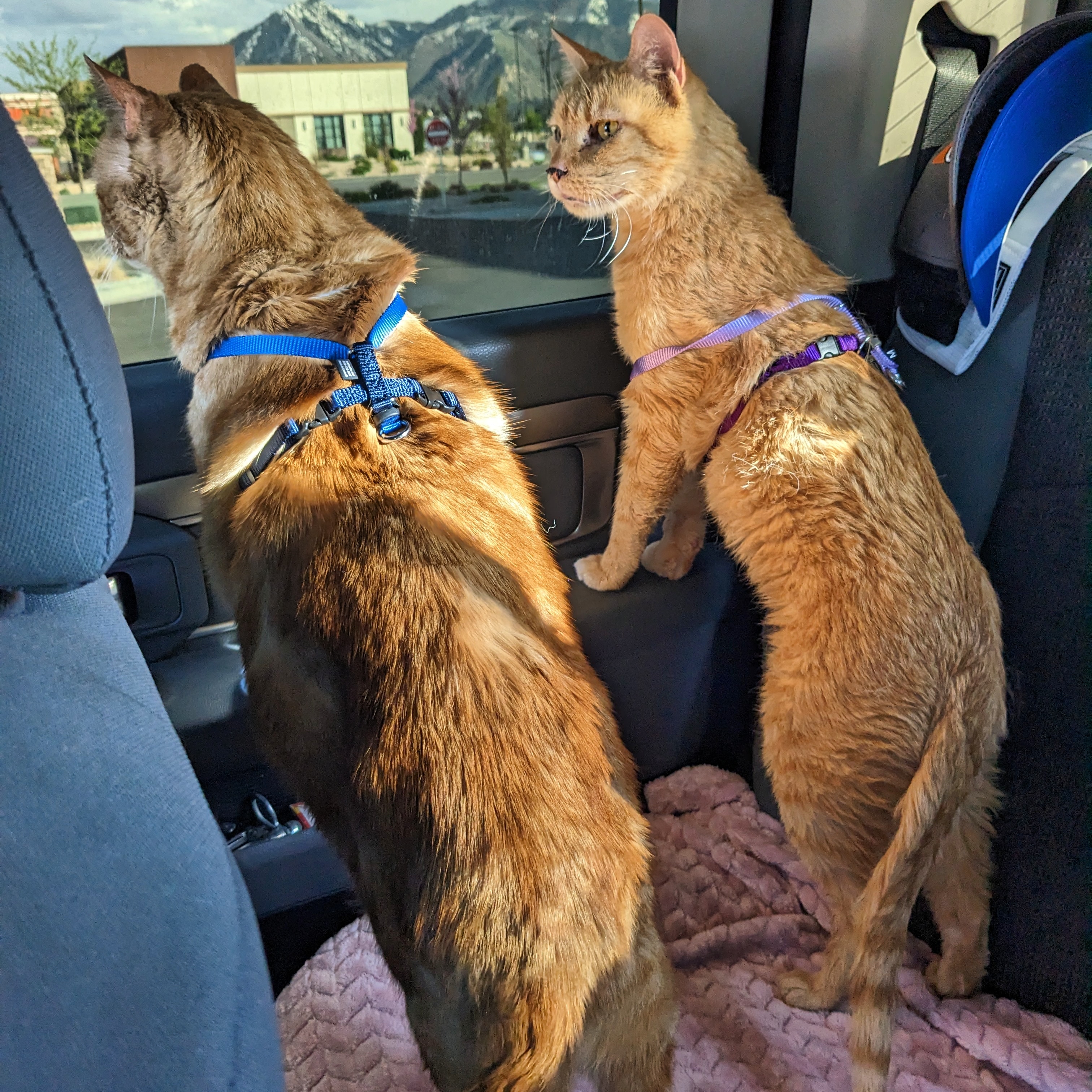
If you’ve followed me on instagram or seen my YouTube videos, you’ve definite seen my two orange tabbies that call our camper home. The smaller one is Ducky, but she more commonly goes by Baby, Loaf, Dumdum, Cheeto Puff, and Spitty Baby. She’s 4 years old, and we adopted her in June 2021 after we moved to Utah. She loved to cuddle, sleep with her tongue out, and lay on your neck like a scarf. The bigger one is Mario, but he goes by Chonk, Chonky Boy, and Costco Rotisserie Chicken. He’s a little old man at the age of 7 and a half, and we adopted him in July 2022 after I went to buy food only and walked out with food and a cat.
Travel days
Chonk was a great adventure cat from the beginning. He liked car rides, exploring outside the camper, sitting in his cat tent, and even walking in the snow! For travel days, we put his harness on and carry him to the truck. Once we’re ready to move, the harness comes off so he can roam as he pleases. The Baby was a different story. She was NOT having it in the truck, but she has gotten much better! Here’s how we got her comfortable in the truck:
Starting off slow: we first tried her harness on inside the camper for a few hours at a time before we ever took her outside. She’s a runner, so if your cat is like her, you want to make sure that harness is secure. I gave her some treats I like to call her “sleepy treats,” which are just some anxiety treats for pets. I got them from PetSmart after doing tons of research. I’d give her 30 minutes or so after eating the treats before putting her harness on. This definitely helped in the beginning when she was getting used to the harness going over her head.
Introducing the truck: once her harness wasn’t scary anymore, we started taking her into the truck. For the first few times, we didn’t even turn it on. We placed her in the truck with us and sat there while she roamed. Then she graduated to sitting in the truck with it turned on but not moving. After that step, we’d drive around the block a few days a week with her to get her comfortable. We did all of this in the months before we started traveling full time.
Treats: plenty of treats were used to coax her into the truck. We would (gently) toss her into the truck, but she got treats before, during, and after the excursion. And plenty of cuddles.
Introducing the crate: we learned soon after introducing her to the truck in a harness that a crate may be better for her needs. I found a crate on Amazon for a small dog, so it’s quite roomy for a small cat. We started out with the crate open in the camper with her favorite blanket inside so she could explore as she pleased. Now, we put her in the crate to carry her to the truck as she seemed to fight less. I think it was because she knew she was contained and couldn’t fall, jump, etc. Once in the truck and ready to move, we open the door to the crate for her to roam freely. Sometimes she goes back in to lay on her blanket, and usually she goes back in when she knows we’ve stopped somewhere. We do close her in the crate whenever we need to open the truck doors because she is very fast and is a flight risk.
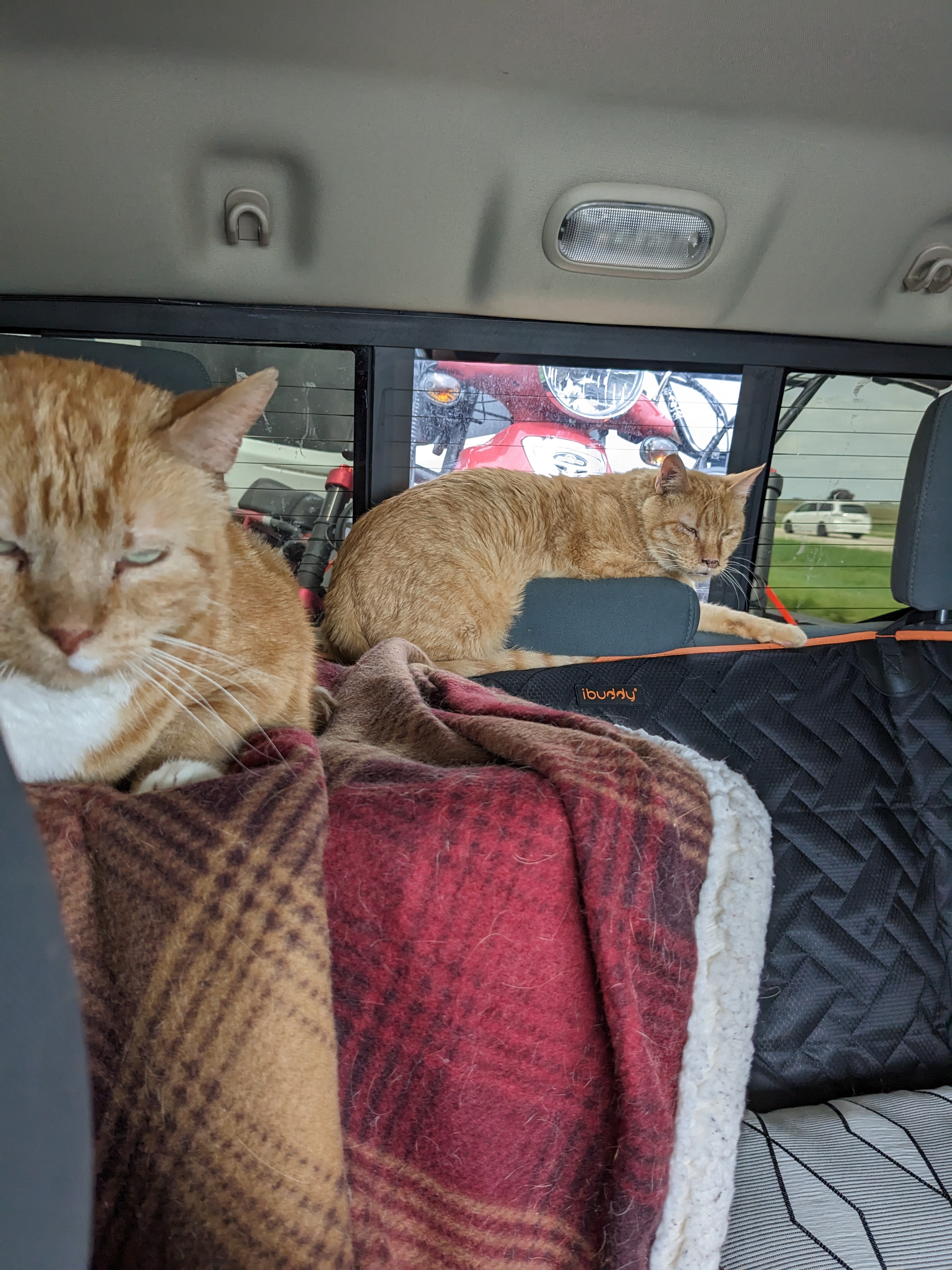
Our cats can handle up to 6 hour travel days (longest we’ve been with them so far), but we prefer to keep in under 5 hours and with a lunch break if it’s over 3 hours. We tend to stop in Walmart parking lots for lunch because we can push the slides out and toss the cats in to let them use the bathroom, eat, and hydrate. I’ve tried bringing food and water with us on travel days, but they don’t seem to want anything other than treats. They’ll eat the treats no problem though! If you’re worried about accidents, I’d recommend getting seat covers for the back seats and bringing a litter box with you. We don’t bring the litter box, but we do have the back seat covers, just in case.
Cat-friendly RV
Since we moved into the RV with cats, we were prepared to make a few modifications to accommodate litter boxes, feeders, and anything else they needed.
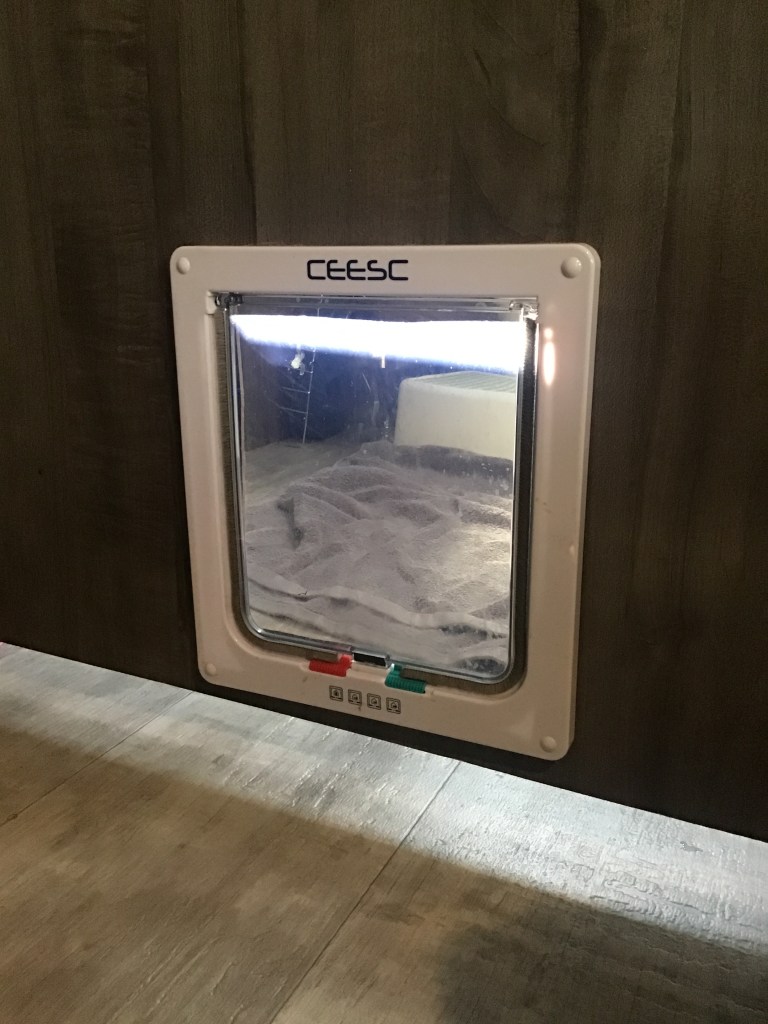
The biggest modification we made was adding cat doors to the bathroom door and the closet door where their litter box is housed. I found extra large cat doors on Amazon to make sure the Chonk would fit through them. I was going to buy a second one for the closet door, but we ended up using the back of the one I already had for the bathroom door instead.
The bathroom closet houses the litter box, extra food, and one of the two feeders. The cats access this area through the hole we cut in the door.
Their litter box pads, pellets, treats, and medicine (for Chonk’s allergies) lives in the towel closet. The rest of their stuff is scattered around the camper. The other feeder is in the living area closer to their water fountain. We bought a scratching pad to hopefully get Chonk to stop scratching the furniture (it worked), and we applied some sticky tape to the couch in the meantime to deter scratching (which also worked). Their extra toys, harnesses, and leashes live in the organizers we added to the fronts of our cabinet doors near the main door.
Conclusion
Is RV life with pets troublesome? I’d say no, personally. We have enough space for us and the cats to happily live in the camper, even if Chonk attacks your feet. Even if the Baby sneezes on me every chance she gets. I wouldn’t trade RV life with pets for the world. If you’re training your cats for travel, definitely go slow with it. I’m happy to answer any questions about the topic below in the comments!
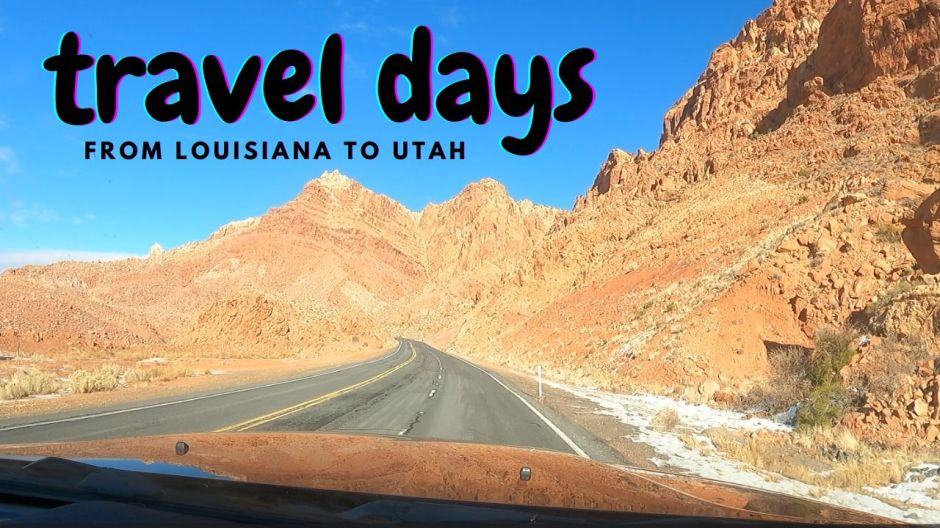
We’ve driven from Louisiana to Utah three times now, two with a camper and one without. I can’t say it’s an easy drive, but it’s definitely not the hardest one I’ve been on with the camper. Although driving through Dallas did give me a run for my money. Starting in the east, it’s fairly flat until you hit New Mexico where the altitude jumps significantly. Then you can enjoy the hills, rocks, mountains, and canyons as you drive over and up to Utah.
I took this trip to work on my goal to document our travels more throughout the year. Not only did I vlog about our travels and impromptu changing plans, but my husband set up our GoPro in the truck! Ever since he bought the GoPro last year I had wanted to use it for travel days, but we either kept forgetting to grab it from its resting place before travel day or we didn’t have any blank sd cards. Well, we bought some sd cards in Texas on our first stop – the overnight in the Walmart – and he set it up the next morning.
I thoroughly enjoyed editing the video with vlog elements and travel footage, and I can’t wait to do it again on our next trip planned in March! If you’d like to see how the trip from LA to UT went, how we survived the Walmart parking lot, learn out our off grid battery setup, or just to judge my editing skills, check it out below!
It’s very strange coming back to Utah after being gone for so long. I had been missing it since we left in June, but I didn’t expect to miss it even more once we were back.
Part of the reason we started RV life was to travel and see where we would like to settle down eventually. It’s not that we didn’t think Utah was that place, but we wanted to make sure we weren’t just trying to buy a house to check it off the list and end up realizing a year or two in that we wanted to be somewhere else. After full timing for almost a year and being in the east since June, we have definitely decided we missed the west. Well …. I don’t think we ever stopped missing the west. But we definitely were able to determine our forever home location would be in the west.
It’s weird though still wanting to travel but wanting to look for a house at the same time. So we’re focusing on paying down some debt first and casually looking in the area to see what we might be interested in. This definitely is not a goodbye RV life!!! Just a look into the next step. We’re in our mid-20s, and RV life was a nice way to get out of the apartment rent increase cycle. We definitely don’t regret RV life, but now I feel like it’s becoming more intentional. Travel slower, enjoy new places, check off more states. The timeline has become more finite.
Sometimes I do miss the apartment, but mainly for three reasons:
Bathtubs
Decorating
Lounging on the balcony
I’ve always loved baths, and I realize if I really want to take a bath I can book a hotel room. This was something I knowingly gave up and accepted, but I still miss it.
Decorating the camper was extremely intentional as I only have so much space to store seasonal decor and so much space to display things. Of course, I kept a few things from the apartment like pillows, blankets, and a few wall decor items that are out and about, but buying new decor is very uncommon. Especially new seasonal decor.
The balcony was a huge reason we got the apartment we did because it faced the mountains. We had lounge chairs, and I had a plant ladder with tons of plants. The plants oddly were a way I delt with anxiety. Caring for the plants felt like I was caring for myself. But I couldn’t take the plants with me into the camper. The pots were ceramic, we had no flat spots to put them, we had no where to keep them when we moved, and the cats could NOT eat them. I love sitting outside the camper in our camp chairs when the weather is nice or at night next to a fire, but there’s something about a balcony (or a porch I suppose) that I miss.
I cannot thank RV life enough for what it’s done, and I realize we never would have done what we did this year without it. I couldn’t imagine leaving the camper now, but somewhere in the future … It would be nice to have a house to come back to when we’re stationary.
Hey y’all! The past two weeks have been a whirlwind of weather-related travel plan changes. Originally, we were to leave Louisiana after visiting both of our families for the holidays, take about a week to head to Moab, UT, then hang out there a few nights to test our dry camping system before heading back to Provo, UT.
Well that certainly didn’t happen as planned. The snow coming from the west said “nope!”
Changing plans has been a touchy subject for me and other type A’s. However, this didn’t create too much extra anxiety for me as I thought it would. When we were just staying one extra day in New Mexico, it was nice. We were taking a break from driving and had already budgeted a flex day before we got to Moab in case we had an unplanned stop. When we got to Gallup, NM though, our Moab plans went out the window. First we were waiting for snow to clear in NM then heading to Moab, but the weather was freezing and cloudy in Moab. Then we were waiting for it to get a little sunnier in Moab, but it started snowing again in NM. It felt like a lose lose scenario. If we waited a few more days we’d be able to make it to Moab, but there was a high chance the mountain pass we had to take to Provo would be under 12 inches of snow and icy. And I don’t know about you, but I’d rather not be towing a camper over ice through a mountain pass.
So our plans morphed again, but this time we’d take the southern route into Utah through Arizona. Which is the way we went when we moved out here in 2021. That route stuck, and miraculously we made it to Provo on the day we planned to arrive at the campground originally. So no days lost!
Although it worked out in the end, it’s hard to make plans and see them change so quickly. Surprisingly though, I wasn’t too upset. Instead I was focusing on how hard I fought to leave the south and how miserable I was during the summer and how I’d happily accept being stuck in New Mexico. At least there was snow and rocks.
A lot of things didn’t go right last year compared to our original travel plans, and I want this year to be better. But if it’s going to be better, I also have to accept that plans can change. And that’s ok. We have tentative plans for where we want to be in a given month, but it’s not the end of the world if those plans change. Am I allowed to be disappointed? Yes. But I’m working towards finding the silver linings.
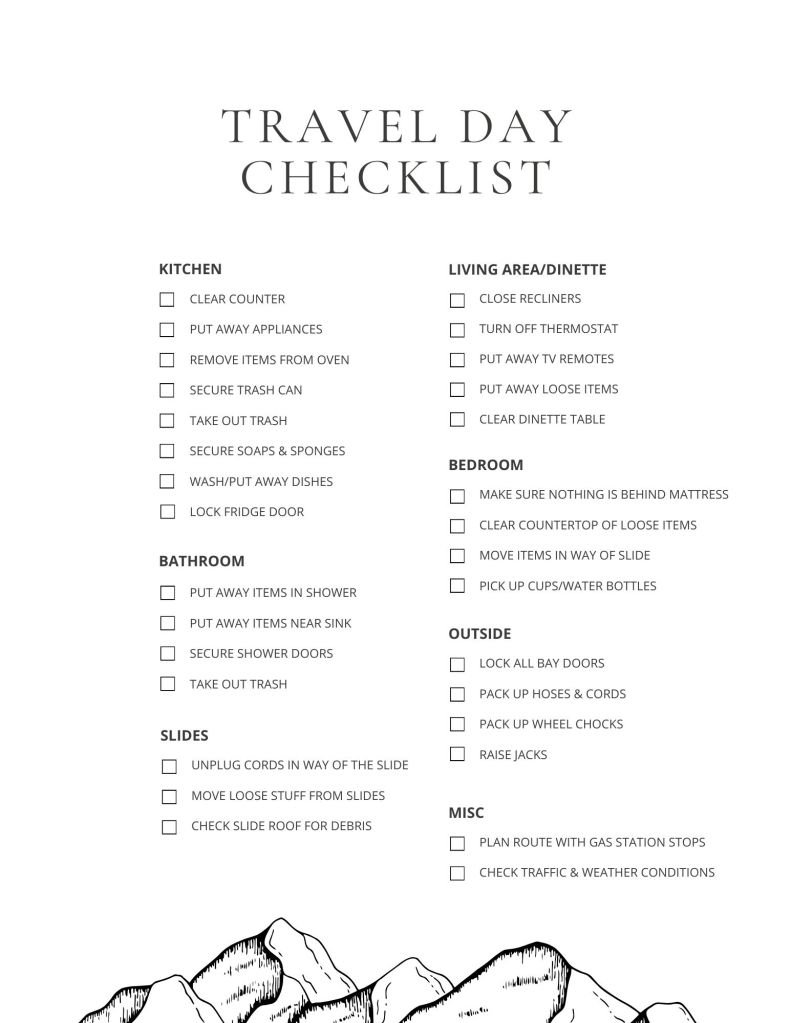
Have you ever ran around your camper the morning of a travel day trying to get things in order? Or are you researching the best way to prevent problems when prepping for travel days i.e. accidentally leaving the fridge unlocked and arriving to the destination with an empty fridge and floor full of food?
I have been both of those people. After our first few travel days, I wrote up a checklist to follow each time we move to make sure setting up and tearing down goes as smoothly as possible. Some of the items can be done the day before like taking out trash, moving loose items into cabinets, and clearing off countertops or tables. Other things are best done right before moving like checking the roof, putting up hoses, and checking travel conditions.
I’ve created a FREE PDF of my checklist which you can access here! I hope you can use it as is or to create your own checklist tailored to your floorplan and type of RV.
I’ve also learned the hard way that planning your route for the day should be done no later than the night before you travel. My personal preference is the evening before because I have a better idea of weather conditions. Weather is always changing which is totally annoying when you’re traveling, especially when random snow showers are popping up!
Our general rule for planning routes is travel less than 350 miles in a day, plan a stop for lunch, and plan gas stations with truck lanes every 100 miles. It’s a lot easier to work in the stops on Google maps beforehand than to be frantically looking for somewhere to stop. Especially traveling out west in reservation land or if you only stop at truck stops.
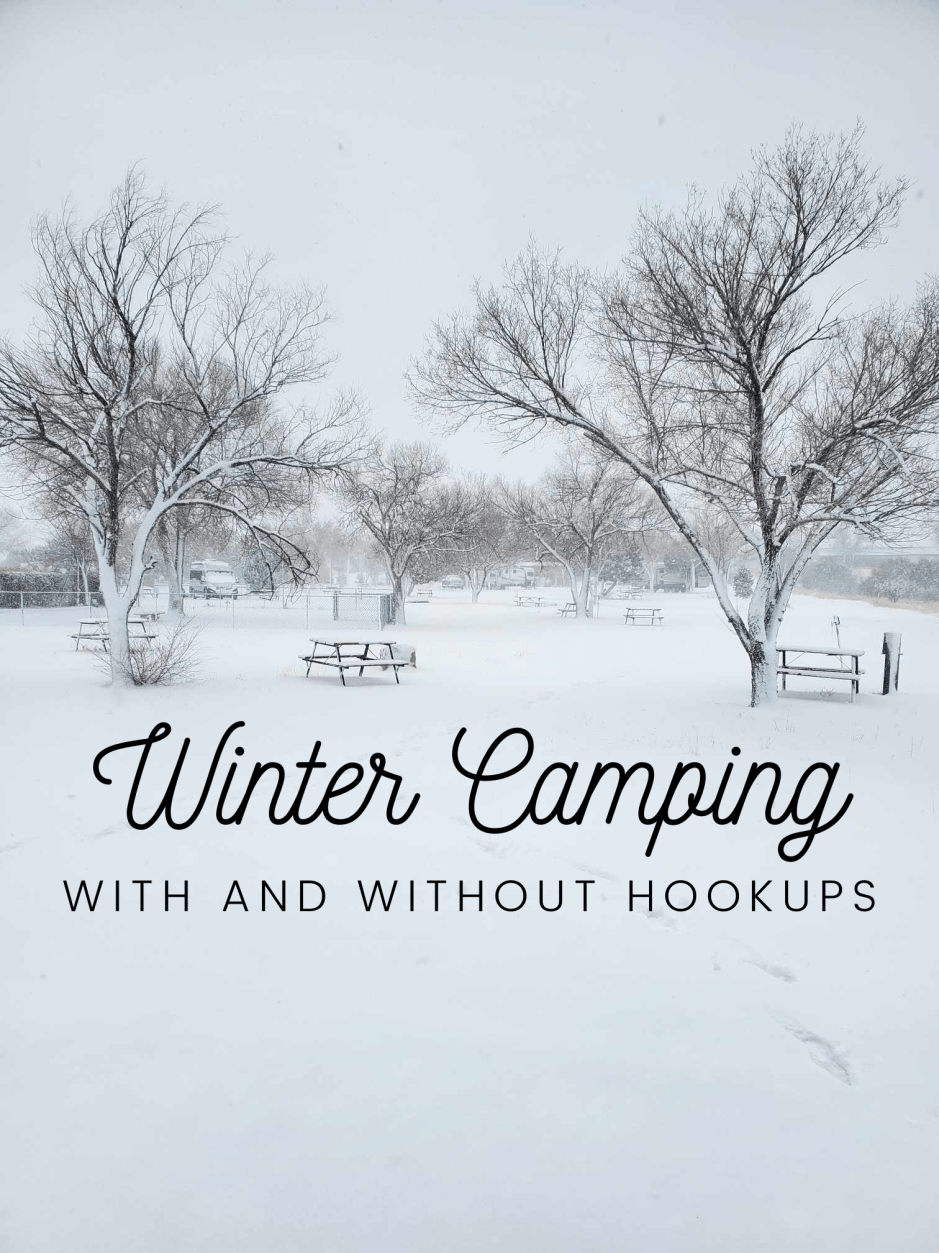
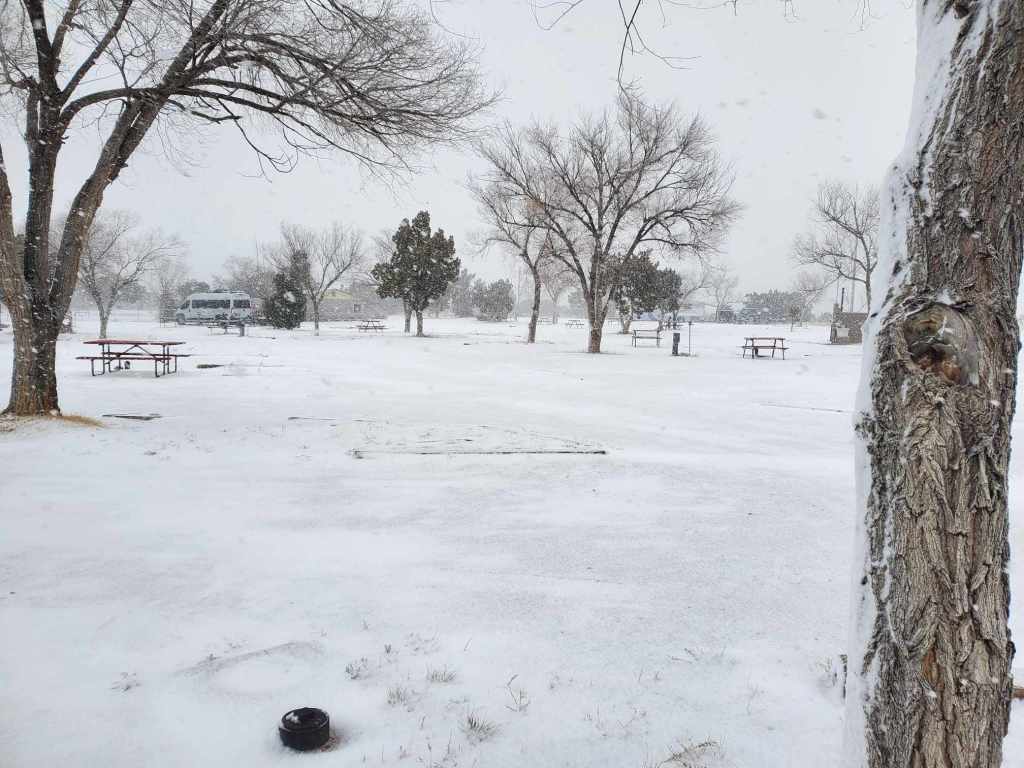
Hey y’all! It’s January, and in many parts of the country it’s cold and snowy. Currently, we’re camping an extra day in New Mexico due to yesterday’s winter storm warning in northwest NM and today’s snow and high winds east of Albuquerque. Today’s snow day has me reflecting on how we stay warm and cozy in freezing temperatures when we have full hookups and even when we don’t!
Winter camping with access to full hookups
Our preferred way to camp in freezing temperatures is with full hookups. Campsites with full hookups offer power, water, and sewer. Some places in the winter have heated water spigots so you can plug in a heated hose to ensure your water doesn’t freeze. If you don’t have a heated hose or a heated spigot, many campgrounds advise you to unhook your water connection by sundown to prevent freezing water and damage to your hose.
We have a heated water hose from Amazon that works well for our needs! The hose we bought is 25ft long. We haven’t had any more issues with freezing water after we started using a heated hose, so this is a must have in our eyes.
If we’re hooked up to power, we use our tank heaters to keep our tanks warm and safe! We also have a fully insulated and enclosed underbelly. Our floors are not immune to getting cold, so we sometimes run the propane heater to warm up the floors. We usually keep the propane heater thermostat set pretty low because my husband and I like the cold. We’d rather add on layers and blankets than be sweating!
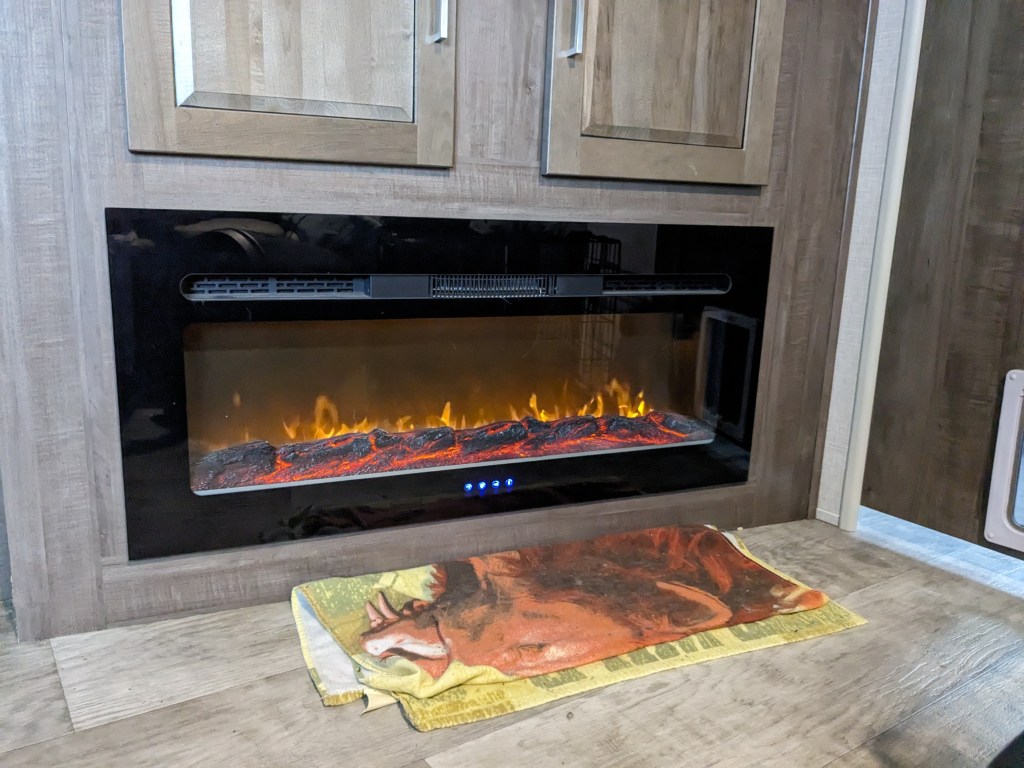
Besides the propane heater, we also have an electric fireplace. This is our main source of heat when we’re hooked up to power. Just a few minutes with this thing on, and the whole camper is nice and toasty! Plus I really enjoy the flames. In the bedroom we have a small space heater that we turn on sometimes to take the chill out of the air when getting up in the morning.
(The towel is the Chonky boy’s towel. He liked to lay on the mat in front of the sink but would get mad if we stepped around him while cooking, so a sacrificial towel was placed by the fireplace. Now he sits there during the day)
Winter dry camping
We had our first dry camping experience in this rig earlier in the week! The outside temperatures were in the 20s, so cold but not below zero. We were camping in a Walmart parking lot in Texas, so we had room to push the slides out and run the generator if needed. Without power hookups, we set the propane heater to kick on if it got too cold and we didn’t use the fireplace. We kicked on the space heater for a few minutes to take the chill out of the air. Our power set up allows for us to kick on the space heater or fireplace, but both draw around 1200-1500 watts so we wouldn’t want to use them for too long.
As far as water went, we didn’t turn the tank heaters on because we didn’t want to deplete our house batteries during the night. Since our underbelly is fully enclosed, we determined it would be fine to leave the tank heaters off. And it was fine! No water issues. Had we been camping in sub-zero degree temperatures, we would have ran the tank heaters and used the generator to charge up the house batteries.
2023 was a crazy year for us – we left our apartment to move into our camper, we traveled across the country, we upgraded our Thousand Trails membership, and I started a YouTube channel to name a few things. While I’m excited to see what 2024 holds, I wanted to make a few goals for myself. I wouldn’t call them resolutions because it’s ok if I don’t complete them, but it’s still something to work towards.
Goal 1
Explore more of the northern US. This seems super broad, but Glacier National Park has been on my bucket list forever and a day, and we’re finally planning to go this summer! I don’t want to stop there though. I want to explore Idaho, Michigan, Vermont, and everything in between! Leave a comment down below with the most northern state you’ve been to (mine is New York).
Goal 2
Be less uptight and learn to go with the flow of life. This is one I’ve been working on for all of my life, but my type A personality hasn’t quite let that happen. I’ve already had a great start to the year with this goal though! Yesterday and today I booked a campsite for that night. I’ve never booked campsites less than a week out let alone the same day! This seems super small, but I allowed myself to accept that if our original destination wasn’t suitable, it’s ok for the plan to change. And that’s exactly what happened. And I rolled with it.
Goal 3
Document my travels and RV life more frequency. Specifically, I want to make candid, long-form content like YouTube travel vlogs and personal blog posts. The origins of anxietyinacamper were to share my travel anxieties, which transitioned into sharing my RV life. I enjoy making funny reels, informational videos, and upgrade how-to’s – and I will continue to make those – but I want to remain true to the reason I started my account. Not to go viral, not to get sponsored. Just sharing the highs and lows of traveling. With some campground reviews, tips, tricks, upgrades, and cats sprinkled here and there.

 anxietyinacamper